
The Most Expensive Commercial Glass Mistake Isn't the Break
It’s what happens after. What property managers and building owners across Houston and North Houston need to know about commercial glass before a small problem becomes a very costly one.
How many glass issues on your properties right now are sitting on the "deal with it later" list?
A slow seal failure. A crack that hasn't spread — yet. A storefront panel that got boarded up temporarily three months ago and never properly replaced. A door that doesn't quite close the way it used to.
You know the list. Every property manager does.
And if you've been in this business long enough, you also know what happens to that list. "Later" arrives. And by the time it does, the small problem isn't small anymore.
We've been doing commercial glass work across Houston and North Houston for 28 years. We've seen what happens when repairs get deferred, when the wrong contractor does a rushed fix, and when a property manager inherits a system that was installed incorrectly from day one.
The pattern is consistent: the problem that costs the most is almost never the original one. It's everything that compounded after.
Why Commercial Glass Fails — and It's Rarely Random
Glass doesn't just break for no reason.
When we're called to a property with a recurring glass problem — the same panel cracking repeatedly, a seal that fails again after being replaced, a door that keeps falling out of alignment — there's always a root cause underneath it. Finding that is the difference between a real fix and a temporary one. Here's what's actually behind most commercial glass failures we see.
Installation errors that show up months later. Everything looks fine on day one. Then the cracks start. Improperly shimmed frames put ongoing stress on the glass. Missing sealant lets moisture work into the system quietly. Glass installed without accounting for thermal expansion — and in Texas, the swing between a January cold snap and a July afternoon is significant — develops stress fractures that seem to appear from nowhere.
The wrong glass specification. Commercial glass isn't one-size-fits-all. The correct type and thickness depends on the opening size, location in the building, foot traffic, and local code requirements. Annealed glass where tempered is required. Single-pane where the building's energy demands call for insulated units. The wrong spec gets installed, performs poorly, and everyone wonders why it keeps failing.
Seal failure in insulated glass units. The visible sign is fogging between the panes — condensation you can't wipe away because it's trapped inside. What most property managers don't realize: by the time you can see the fogging, the seal has often been failing for a long time. The unit has to be replaced. The seal can't be repaired from the outside.
Deteriorating aluminum framing. Aluminum storefront frames corrode, warp, and loosen over time — especially in Houston's humidity. A compromised frame transfers stress to the glass and affects how panels and doors seat. Replacing glass while leaving a bad frame in place is a fix that creates the same problem again within a year.
Deferred maintenance that crossed a line. A minor edge crack can be monitored — for a while. But cracks propagate, especially under thermal stress. Stable in November. Significantly worse by July. The window for a cost-effective repair closes faster than most people expect.
The Number That Should Get Your Attention
Here's something worth knowing.
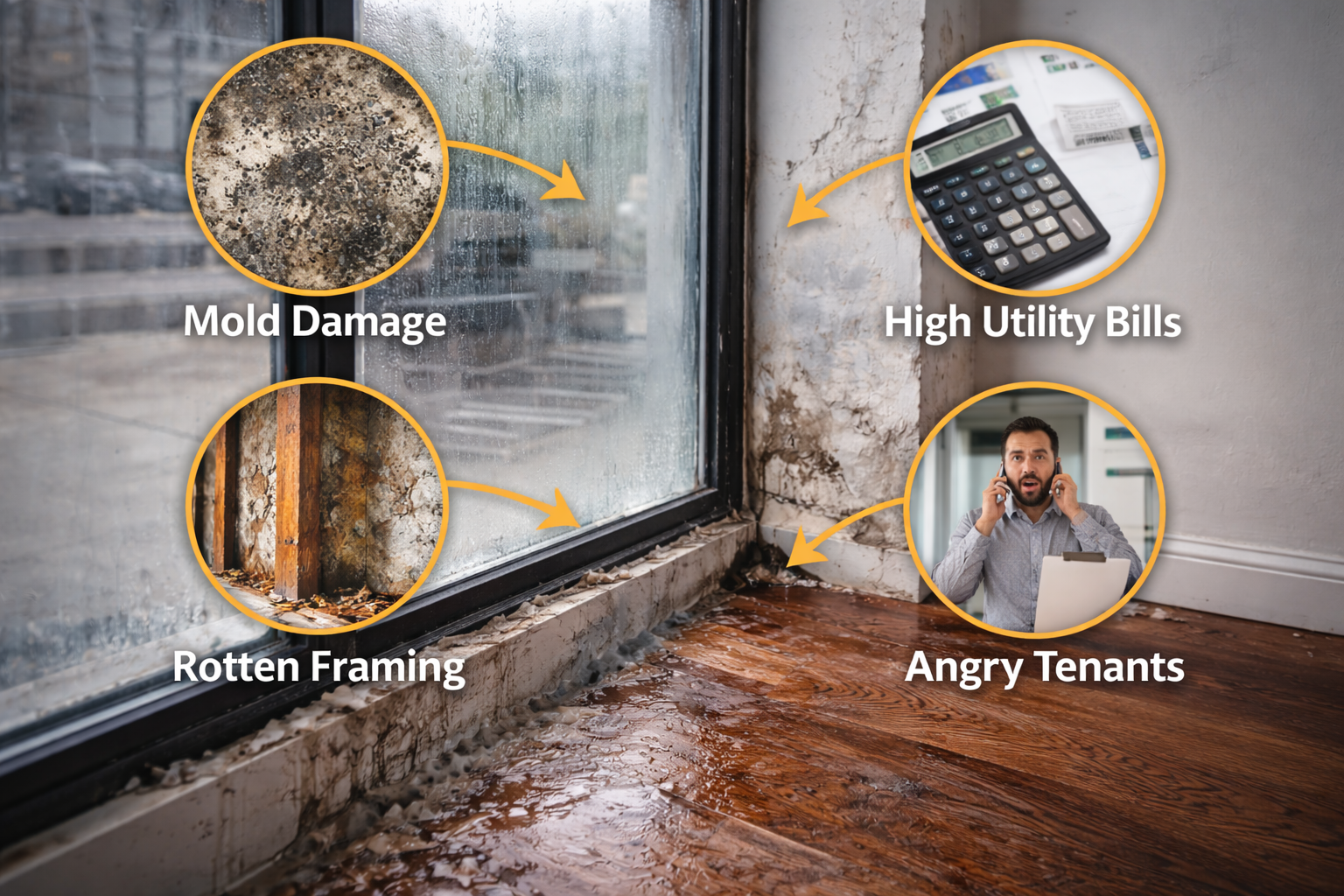
Research finds that by the time a tenant notices a glass problem — a draft, fogging, a visible crack — the underlying failure is often months or even years old. At that stage, you're no longer looking at a simple glass repair. You're potentially looking at moisture damage to surrounding framing and interior finishes, rising utility costs from failing insulation, and tenant complaints that start affecting lease renewals.
The costs compound fast. According to BOMA International, deferred commercial property repairs cost an average of four times more to fix than if they'd been addressed when first identified.
We've walked into properties where a failed dual-pane seal was ignored long enough that moisture damaged the surrounding framing and interior finishes. What should have been a straightforward glass replacement turned into a significantly larger remediation. The glass wasn't the expensive part. The time it had to cause secondary damage was.
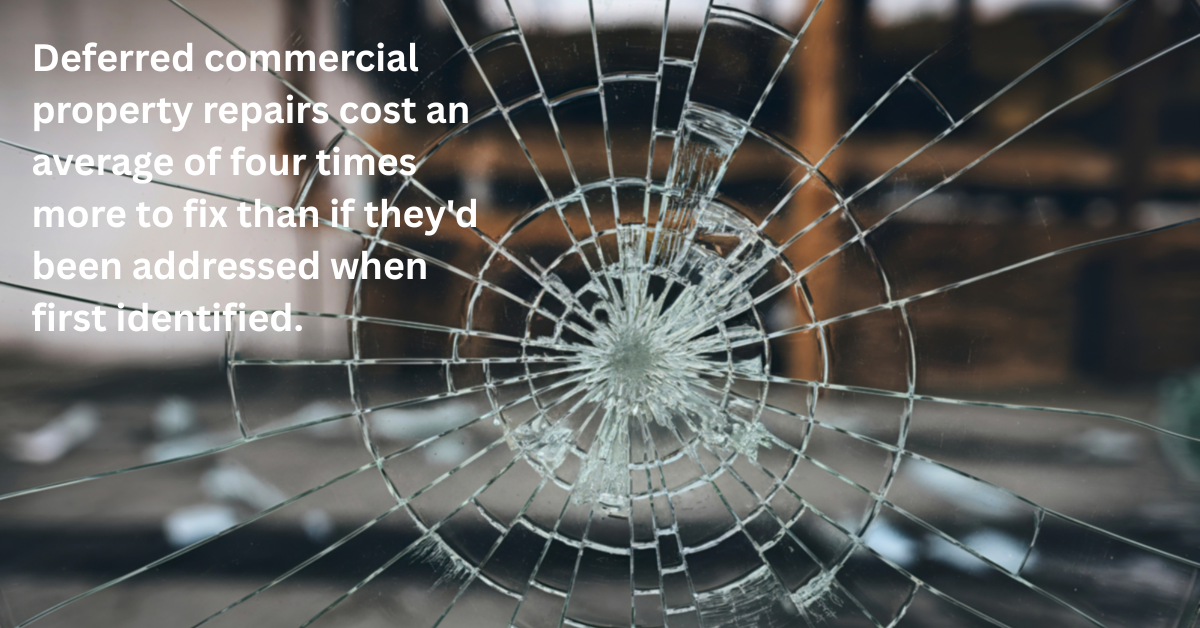
Deferred commercial property repairs cost an average of four times more to fix than if they'd been addressed when first identified.
Beyond the Repair Bill — The Costs Nobody Talks About
The direct cost of glass replacement is easy to see on an invoice. What's harder to quantify — but just as real — are the downstream effects.
Tenant complaints and turnover. A deteriorating storefront reflects on the property and on management. Long-term tenants notice when issues go unaddressed.
Failed inspections. Glass with the wrong spec gets flagged during tenant build-out inspections. That becomes the property owner's problem to resolve before the tenant can open — a delay with real dollar consequences.
Liability exposure. Glass near entry points or at low height that doesn't meet tempering requirements is both a safety risk and a legal one. This isn't theoretical.
Energy costs. Failing seals and inadequate glass spec increase HVAC load. In a Houston summer, that's not a minor consideration. Tenants feel it as a comfort issue long before they can measure it as an energy cost.
What a Good Commercial Glass Contractor Actually Does
Most property managers have dealt with a glass contractor who shows up, replaces the broken thing, and leaves. No root cause. No conversation about whether the frame is the real problem. Just a new pane in an old system — and the same call six months later.
Here's what we do differently.
We look at the whole system, not just the damaged piece. When we're called to replace a cracked panel, we're also evaluating the frame condition, the sealant, the glass spec, and whether the surrounding installation is sound. If there's a reason the glass failed beyond just impact, we tell you before we write up the repair.
We give you the real answer on repair versus replacement. If the frame is solid and the damage is isolated, repairing the glass is the right call. If the framing is deteriorated or the system was installed incorrectly, we say so — because a repair that fails again in twelve months helps nobody. See how we approach commercial glass repair and replacement on active properties.
We spec the correct glass for the location. Code-compliant, correct thickness, correct type for the use. Our work passes inspection the first time because we make those decisions correctly at the start — not after a failed inspection on your property.
We price it clearly before anyone starts work. Text us photos of the opening and we can often give you accurate pricing before we set foot on site. What we quote is what you pay.
What to Watch for on Your Next Property Walkthrough
Put these on your checklist. Catching these early is the difference between a scheduled repair and an emergency.
Fogging between panes — failed insulated unit, needs replacement, not monitoring
Cracks running to the edge of a panel — these propagate under thermal stress, especially in summer
Doors that don't close flush or latch cleanly — frame or hardware issue that's also stressing the glass
Sealant pulling away from the frame — water and air infiltration follow shortly after
Glass near doors or at low height that may not be tempered — worth confirming now, not after an incident
Aluminum framing that's visibly corroded, bowed, or loose — the glass failure follows the frame failure
Frequently Asked Questions
How do I know if I need a repair or a full replacement? It comes down to the condition of the glass, the frame, and the surrounding system. If the frame is solid and the damage is isolated, replacing just the glass often makes sense. If the framing is compromised or the system was installed incorrectly, we'll tell you directly — because a repair that fails again in a year isn't saving you anything. We walk through this on every job. Learn more about our commercial storefront glass services.
Does Texas have specific code requirements for commercial glass? Yes. Glass type, thickness, and tempering requirements vary based on location in the building, proximity to doors, opening size, and local jurisdiction. We select materials to meet those requirements from the start. Our work is inspection-ready before the inspector shows up.
How quickly can you get to a commercial glass issue? Depends on what you're dealing with. Emergency situations — broken storefronts, unsecured openings — we respond to fast. Scheduled repairs are planned around your tenants and operations. Call or text and we'll give you a real timeline based on your specific situation.
Can you work on active properties without disrupting operations? Yes. Most of what we do is on active commercial properties — retail, office, strip centers. We plan work around operating hours and can handle same-day removal and reinstallation when the job allows.
What does the 90-day warranty cover? Storefront and door components we install or repair. If something isn't right within that window, we come back and fix it. No runaround.
What areas do you serve? We're based in Spring, Texas and serve the full Houston and North Houston corridor — Spring, Klein, The Woodlands, Conroe, Willis, Tomball, Magnolia, Cypress, Katy, Humble, Kingwood, Atascocita, Porter, Splendora, Sugarland, Missouri City, and Richmond. Not sure if we cover you? Call or text and ask.
The Right Fix Costs Less Than the Wrong One
Commercial glass problems don't get better on their own. The ones that get deferred get more expensive. The ones that get patched by the wrong contractor come back. After 28 years of this work across Houston and North Houston, that's not an opinion — it's just what we see, consistently, on properties throughout this area.
If you've got glass issues sitting on that list right now — whether they need attention today or you're trying to get ahead of them — reach out. We'll give you straight answers about what's actually going on and what it will take to fix it correctly.
Call or text (281) 877-2000 Text photos of the glass or opening for faster, more accurate assessment. Or submit a service request at glassworkshoustontx.com.
28 Years of Commercial Glass Experience · Installer-Only & Owner-Operated · 90-Day Warranty on Storefront & Door Components